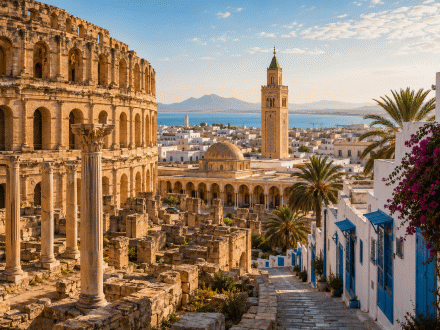

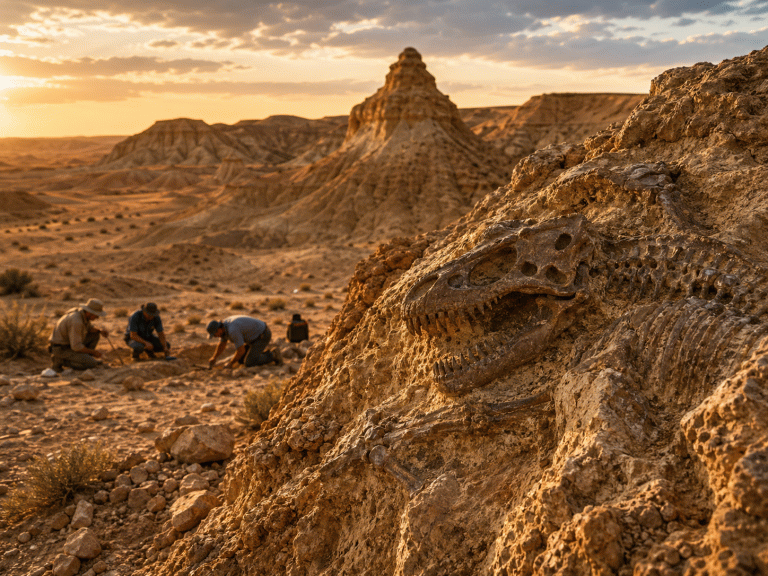
Southern Tunisia has revealed traces of prehistoric life, including dinosaur footprints and fossils near Tataouine and Chenini. This article introduces the discoveries and explains why the region is important for travelers interested in geology, desert landscapes, and the deep history of the Tunisian south.
Tunisian and foreign geologists have discovered herbivore and carnivore dinosaur footprints in southern Tunisia. The footprints were located in a mountain near the Berber village of Chenini, about 20 km from Tataouine.
The first discovery of dinosaur fossils in the area dates back to 1995. Teeth, a femur, and vertebrae are displayed at the Museum of Memory of the Earth in Tataouine. The discovery of these footprints leaves no doubt about the existence of dinosaurs in Tunisia.
The argument that the fossils found in the area came from Libya and were carried here by streams of water after heavy rains has been ruled out. Habib Aljane, curator of the Museum of Memory of the Earth in Tataouine, explained the history of this discovery.
According to his account, it was in early February, during excavation with a delegation from the University of Bologna in Italy, that an Italian expert noticed footprints he considered unusual. After careful authentication work, the marks were confirmed as dinosaur footprints.
Tunisia has often been submerged by the sea, and almost the entire country is composed of sedimentary rocks derived from marine deposits. Large areas of southern Tunisia date back to the Jurassic period of the Mesozoic era, around 200 million years ago, when dinosaurs ruled the land.
During the Cretaceous period, when dinosaurs already existed, the sea was shallow in the mountain oasis region of southern Tunisia. Similarly, 20 million years ago during the Miocene period, the sea was shallow in what later became the Cap Bon peninsula in northern Tunisia. The main deposits are sand-based, forming compact sandstone at the peaks of El Haouaria and Korbous.
A team from the Esperaza Dinosaur Museum in France opened 21st-century missions in southern Tunisia between Tataouine and the Libyan border, accompanied by Mohamed Ougiah, then a geologist at the National Mining Office in Tunis. These survey missions led to the discovery of a partial skeleton of a large crocodile about 154 to 160 million years old, along with many other isolated fossils.
Surveys carried out during the mission confirmed that, like Hamada Guir in Morocco and the Algerian Sahara, southern Tunisia contains great paleontological wealth. A small dinosaur museum has been opened in Tataouine.
Ask Tunisia Horizon
Geological context: the US Geological Survey places the appearance of dinosaurs in the Triassic, before the Jurassic and Cretaceous.