Tunisia is home to exceptional UNESCO World Heritage sites, including Carthage, El Jem, Dougga, Kairouan, and the Medina of Tunis. This guide gives a clear overview of places that show the country’s ancient, Islamic, and Mediterranean heritage.
With a varied landscape and a long history, Tunisia offers a great deal to see and explore. Tunisia Horizon has listed some of the top attractions and must-visit World Heritage sites in Tunisia. You can also check our Tunisia tours or contact us for a customized tour.
A brief description of top UNESCO World Heritage sites in Tunisia is shown below. If you would like to know more, Tunisia Horizon planners can answer your questions and help you choose the right itinerary.
Amphitheatre of El Jem
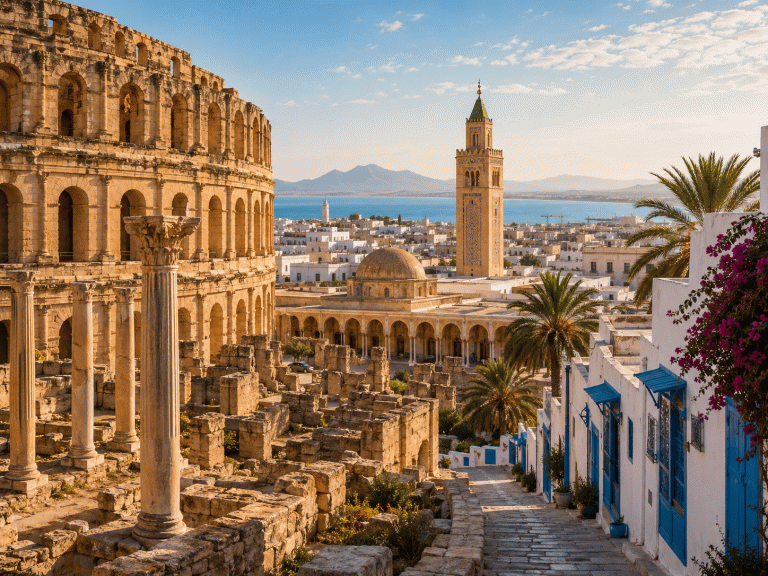
The impressive ruins of the largest Colosseum in Africa are found in the small village of El Jem. This huge amphitheatre could hold up to 35,000 spectators. The 3rd-century monument illustrates the grandeur and reach of Imperial Rome.
The Amphitheatre of El Jem is one of the rare monuments of its kind and is unique in Africa. It was not built against a hillside, but on flat ground and supported by a system of arches. It remains one of the most accomplished examples of Roman amphitheatre architecture.
Carthage
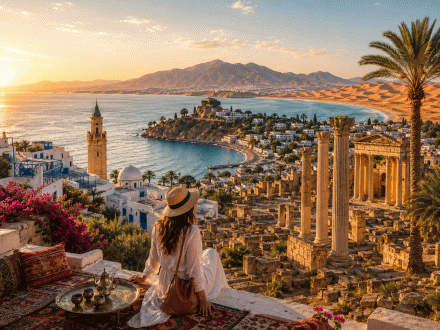
Carthage directly overlooks the sea, where visitors can still admire ancient Roman baths, houses, and places of worship. According to legend, Saints Perpetua and Felicitas, martyrs of African Christianity, were executed in the amphitheater of Carthage.
Founded in the 9th century B.C. on the Gulf of Tunis, Carthage developed from the 6th century onward into a great trading empire covering much of the Mediterranean. It was home to a brilliant civilization. During the long Punic Wars, Carthage occupied territories belonging to Rome, which finally destroyed its rival in 146 B.C. A second Roman Carthage was then established on the ruins of the first.
Important monuments in Carthage include:
- Tophet: Believed to be the place where ancient Carthaginians sacrificed newborns to a deity. Whether myth or reality, it remains one of the questions visitors can explore at the Tophet of Punic Carthage.
- Punic Port: Carthage was a great naval power and possessed one of the most powerful fleets of the ancient world. The Punic port was an artificial protected inner harbor, man-made and found generally in the Phoenician world.
- Antonine Thermal Baths: Among the largest thermae in the Roman world after those of Caracalla and Diocletian in Rome.
- Amphitheatre: The place where Saints Perpetua and Felicity, famous martyrs of African Christianity, were executed.
- Byrsa Hill: The civic center of Carthage, with remains of the earliest Punic quarter, a Punic necropolis, and the Cathedral of Saint Louis.
- Roman Villas: Luxurious villas set on a cliff with a fascinating view over the Gulf of Tunis.
- Water Cistern: A major water cistern in North Africa, collecting water channeled from Mount Zaghouan to Carthage through a Roman aqueduct.
- Carthage Museum: A repository for hundreds of objects found during excavations on the site.
Kairouan
Also known as Kirwan or al-Qayrawan, Kairouan is revered as one of the most important holy cities in the Muslim world. Kairouan was the capital of Ifriqiya, the medieval region comprising the coastal areas of what are today western Libya, Tunisia, and eastern Algeria.
This city remains a purely Arab city filled with outstanding examples of Islamic architecture in Tunisia. Major attractions include the Great Mosque of Okba, one of the largest and oldest mosques in North Africa. Its exterior is dominated by fortress-like walls and a towering square minaret, while the interior features a large central courtyard with 570 re-used Byzantine and Roman columns.
A walking tour is one of the best ways to appreciate Kairouan’s medina and souks and to see the city’s craftsmen at work. At Bir Routa, a decorated camel draws water from a well that some say is connected with the well of Zamzam in Mecca. Nearby, the Mosque of the Three Doors is noted for its elaborate external decoration. Outside the city’s 8th-century walls are the large Aghlabid pools and the lively Mosque of the Barber, also known as the Zaouia of Sidi Sahab.
Medina of Sousse
The Medina of Sousse is an impressive place with an imposing feel. A medina is the historical center of an Islamic town, with ramparts, gates, mosques, Quranic schools, souks, and private house museums that illustrate Islamic architecture.
Places to visit in Sousse include Kalaout el-Koubba, constructed at the end of the 11th or beginning of the 12th century and known for its cupola. Today, it is a museum containing clues about daily life during Ottoman rule.
The Old Ribat watchtower was originally part of a series of monasteries built around A.D. 821 to help protect the city. Its outer walls are high and thick, and visitors can climb the watchtower for a panoramic view. Avenue des Catacombes also gives insight into ancient Roman Catholic burial customs at the end of the third century.
Thugga / Dougga
Dougga is the best-preserved Roman site in Tunisia. The town of Thugga was built on an elevated site 550 meters above sea level in an area once densely populated by Numidians. The city served as one of the royal residences of the Numidian king Massinissa and as the capital of an important Libyco-Punic state.
Dougga flourished under Roman and Byzantine rule but declined in the Islamic period. The ruins visible today give a strong sense of the wealth of the Roman province of Africa.
Phoenician Site of Kerkouane and Its Necropolis
Located at the tip of the Cap Bon peninsula by the sea, Kerkouane was founded in the 6th century B.C. Unlike other Punic sites in Tunisia, this one was not later transformed by Roman or Byzantine settlement. It therefore offers a unique insight into the Punic world. The site was discovered by accident in 1952.
Ichkeul National Park
Ichkeul National Park is located southwest of Bizerte. It is one of the main wintering sites for migratory birds such as the wigeon, greylag goose, ferruginous duck, purple swamphen, and white-headed duck. It is also a stop for many species spending the winter south of the Sahara.
Water buffalo live in the wetlands. The flora includes olive trees, carob trees, and lentiscus. Potamogeton is the most important aquatic plant and an essential food for several migratory birds. The park was classified as a biosphere reserve in 1977 and registered as a UNESCO natural World Heritage site in 1980.
Tunisia Horizon Tourism and Tunisia Trips
Tunisia Horizon is your Tunisia tour tailor-making expert. As an alternative to customizing recommended tours to meet your individual requirements, we can help you tailor-make a first-time tour, doing the things you want in the order you want.