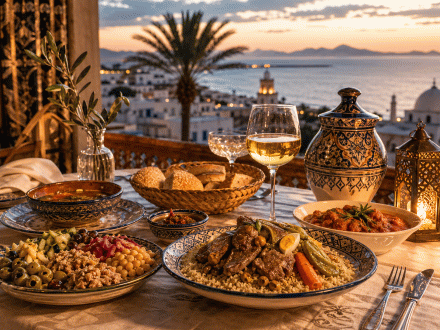

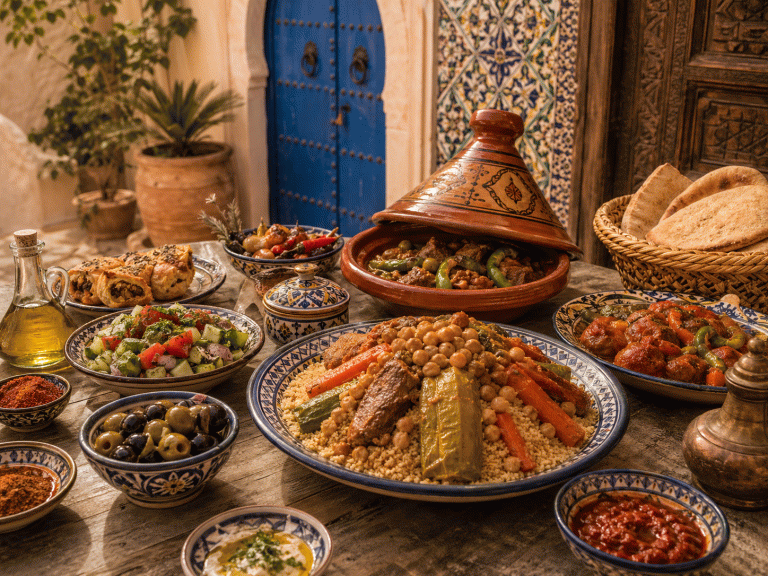
Tunisian cuisine is shaped by olive oil, spices, seafood, lamb, vegetables, harissa, and centuries of Mediterranean influence. This guide introduces popular dishes and food traditions that travelers can discover during a private tour.
Tunisia offers a “sun cuisine” based mainly on olive oil, spices, tomatoes, seafood, and lamb.
Traditional Tunisian Dishes
Brik
Pronounced “breek,” brik is traditionally the second course of the Ramadan meal and is a much easier appetizer to prepare. Deep-fried brik is made from a thin, handmade circular pastry shell called malsouqa, filled with different ingredients depending on the cook’s preferences.
The most popular version is egg brik, filled with a whole egg, parsley, and tuna. Ingredients such as capers and cheese may also be added. The pastry is folded into a triangular pocket and is often garnished with a few drops of freshly squeezed lemon juice.
Tunisian Salad
Salata Tounsia is another starter. It is normally made with cucumber, tomato, and onion, all finely chopped and served with olive oil and lemon. Other versions include egg, tuna, peas, beans, or lettuce, depending on who is serving it. This simple dish highlights the freshness of Tunisian vegetables.
Salad Mechouia
Mechouia is a Tunisian summer salad made with tomatoes and peppers. It is often prepared in two versions: hot and mild, depending on the peppers used. For those who like spicy food, Salad Mechouia is a perfect accompaniment to lamb or grilled fish.
The mild version is usually served as an appetizer or with high-quality tuna, olives, and eggs as an aperitif. It can also be spread on grilled toast or served with baked or fried fish, grilled lamb, or chicken.
Tunisian Tajine
Tunisian tajine is nothing like Moroccan tajine. It is a baked casserole of egg, meat, and spices, similar to an Italian frittata. The meat is often lamb, veal, or chicken, cut into very small pieces and cooked into a little stew with spices such as cinnamon or coriander.
A starchy thickening agent such as bread or potato is added before the egg, cheese, parsley, and mint. It is then baked in a pan until just crisp, cut into squares, and served as an appetizer eaten by hand. The result is a cheesy casserole bite with meat and a variety of flavors. Tajine is not a spicy dish.
Tunisian Couscous
As in the rest of North Africa, couscous is served on many occasions. It is traditionally eaten with lamb. The semolina must be very fine, and the vegetables, such as carrots, small white cabbages, turnips, and chickpeas, are only lightly cooked.
Depending on the season, vegetables may also include cardoons, cold broad beans, or pumpkin. Couscous is semolina cooked with steam and sprinkled after cooking with sauce. The grains can be large, medium, or fine. It is the sauce, with its vegetables, fish, octopus, lamb, beef, or chicken, that creates the many varieties of couscous.
Different spices are found depending on the region, including cinnamon, known as kerfa, or dried and crushed rose buds, known as chouch el ward. Sweetened semolina with raisins and dates makes a special dessert called mesfouf, served with a glass of cold milk.
Khobz Mella
This Bedouin meal holds more anthropological than culinary interest and is one of the ethnic curiosities to try. Khobz mella is a flat bread baked in an open fire in direct contact with embers and hot sand. Since the loaf is unleavened, with no cracks or swellings to trap ash or grit, it brushes clean. It is best tasted by dipping the crust in harissa.
Khobz Tabouna
Khobz tabouna is another type of bread made daily by women in the Tunisian countryside. For several hours a day, country women mix, knead, let rise, shape, and bake flat round loaves of durum wheat bread about the size of an American dinner plate.
The tabouna oven is outside, often just past the women’s courtyard. It is made of baked earth and is blackened by the many loaves baked against its sides. The bread does not lie flat in the oven. Instead, it is sprinkled with cold water and baked vertically against the interior walls, turned periodically as it cooks. The heat of stones inside the oven bakes the bread.
Lamb a la Gargoulette
Gargoulette describes both a terra-cotta vessel and a dish. The vessel is tall, narrow, and unglazed. The dish is lamb stewed with peppers, tomatoes, paprika, and turmeric. The pot is sealed with luting paste, set in a hole lined with coals, buried up to its neck in sand, and finally opened with the blunt edge of a heavy cleaver.
Kefta
Kefta is made by mixing ground lamb or beef with onion, salt, pepper, cinnamon, and allspice, then kneading it into a soft paste. The mixture is shaped into little balls or ovals the size of a small walnut.
The kefta can be briefly fried in oil, shaking the pan to brown the pieces all over, then drained on paper towels. Alternatively, it can be placed on a baking sheet and roasted for about seven minutes in a very hot oven until slightly colored. Serve kefta with tomato sauce and Tunisian carrot salad.
For Tunisian carrot salad, cut carrots into 5 cm lengths and slice them thinly lengthwise. Cook the carrots on a heated oiled grill plate, uncovered, until just tender. Place the carrots in a large bowl with the remaining ingredients and toss gently to combine.
Bon appetit!